
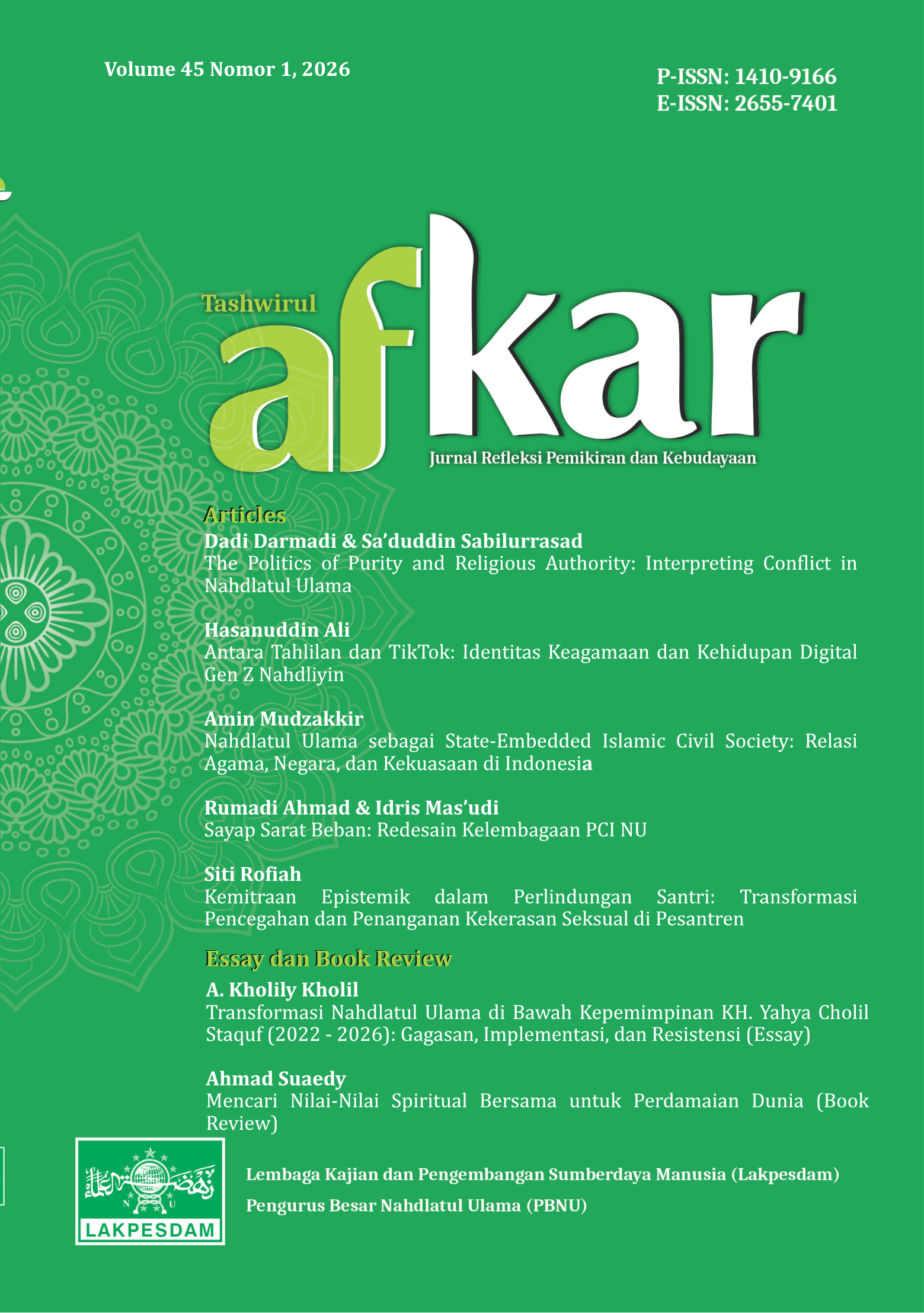
Transformasi Nahdlatul Ulama di Bawah Kepemimpinan KH. Yahya Cholil Staquf (2022 - 2026): Gagasan, Implementasi, dan Resistensi
##plugins.themes.bootstrap3.article.sidebar##
##plugins.themes.bootstrap3.article.main##
Abstract
This article examines whether the organizational transformation agenda pursued by KH. Yahya Cholil Staquf as General Chairman of PBNU for the 2022-2026 term, which he termed Governing NU, can genuinely be called an organizational transformation. This article also traces the points at which resistance emerged along with the challenges it posed. The study employs Max Weber’s theory of authority and legitimacy, which distinguishes legal, traditional, and charismatic authority, with legal authority resting on five foundations: legal norms established through agreement, law as a consistent system of abstract rules, the superior’s own subjection to an impersonal order, obedience rendered purely as a member to the law, and obedience owed to the impersonal order. Data gathered through in-depth interviews with Gus Yahya as well as primary documents comprising organizational regulations, official letters, meeting minutes, and press reports. The findings show that the transformation was realized through three dimensions of consolidation (governance, human resources, and financing) producing twenty-seven organizational regulations, ranging from the DIGDAYA platform, a tiered cadre system, to the Special Bodies. Resistance appeared from the outset and culminated in the November 2025 impeachment. Yet every dispute ultimately reached a regulatory impasse. Non-structural initiatives were blocked by legal authority, and the impeachment argument itself rested on alleged violations of the statutes, sharia, and organizational regulations. The article concludes that a shift from charismatic and traditional authority toward legal authority is discernible, such that PBNU’s trajectory in 2022–2026 succeeded at the level of apparatus but not yet at the level of legitimacy.
##plugins.themes.bootstrap3.article.details##

This work is licensed under a Creative Commons Attribution 4.0 International License.
References
Bush, Robin. Nahdlatul Ulama and the Struggle for Power within Islam and Politics in Indonesia. Singapura: ISEAS Publishing, 2009.
Marijan, Kacung. Quo Vadis NU Setelah Kembali ke Khittah 1926. Jakarta: Erlangga, 1992.
Weber, Max. Economy and Society: An Outline of Interpretive Sociology. Diedit oleh Guenther Roth dan Claus Wittich. Berkeley: University of California Press, 1978.
Peraturan Perkumpulan Nahdlatul Ulama Nomor 2 Tahun 2025 tentang Sistem Kaderisasi.
Peraturan Perkumpulan Nahdlatul Ulama Nomor 8 Tahun 2025 tentang Badan Khusus.
Peraturan Perkumpulan Nahdlatul Ulama Nomor 19 Tahun 2025 tentang Transformasi Digital Nahdlatul Ulama.
Buku Himpunan Peraturan Perkumpulan Nahdlatul Ulama Tahun 2022. Jakarta: PBNU, 2022.
Buku Kompilasi Peraturan Perkumpulan Hasil Konferensi Besar Nahdlatul Ulama 2023. Jakarta: PBNU, 2023.
Hasil Sidang Komisi Organisasi Konferensi Besar Nahdlatul Ulama Tahun 2024. Yogyakarta: PBNU, 2024.
Keputusan Musyawarah Nasional Alim Ulama dan Konferensi Besar Nahdlatul Ulama Tahun 2025. Jakarta: PBNU, 2025.
Dokumen Risalah Rapat Harian Syuriah Pengurus Besar Nahdlatul Ulama, 20 November 2025.
Dokumen Laporan Pertanggungjawaban Lembaga Kajian dan Pengembangan Sumber Daya Manusia (Lakpesdam) Pengurus Besar Nahdlatul Ulama.
“Ini Pernyataan Gus Yahya yang Disebut Cak Imin Nggak Ngaruh buat PKB.” detikNews. Diakses 10 Juli 2026. https://news.detik.com/berita/d-6070416/ini-pernyataan-gus-yahya-yang-disebut-cak-imin-nggak-ngaruh-buat-pkb.
Staquf, Yahya Cholil (Ketua Umum Pengurus Besar Nahdlatul Ulama). Wawancara oleh penulis. Jakarta, 23 Mei 2026.