
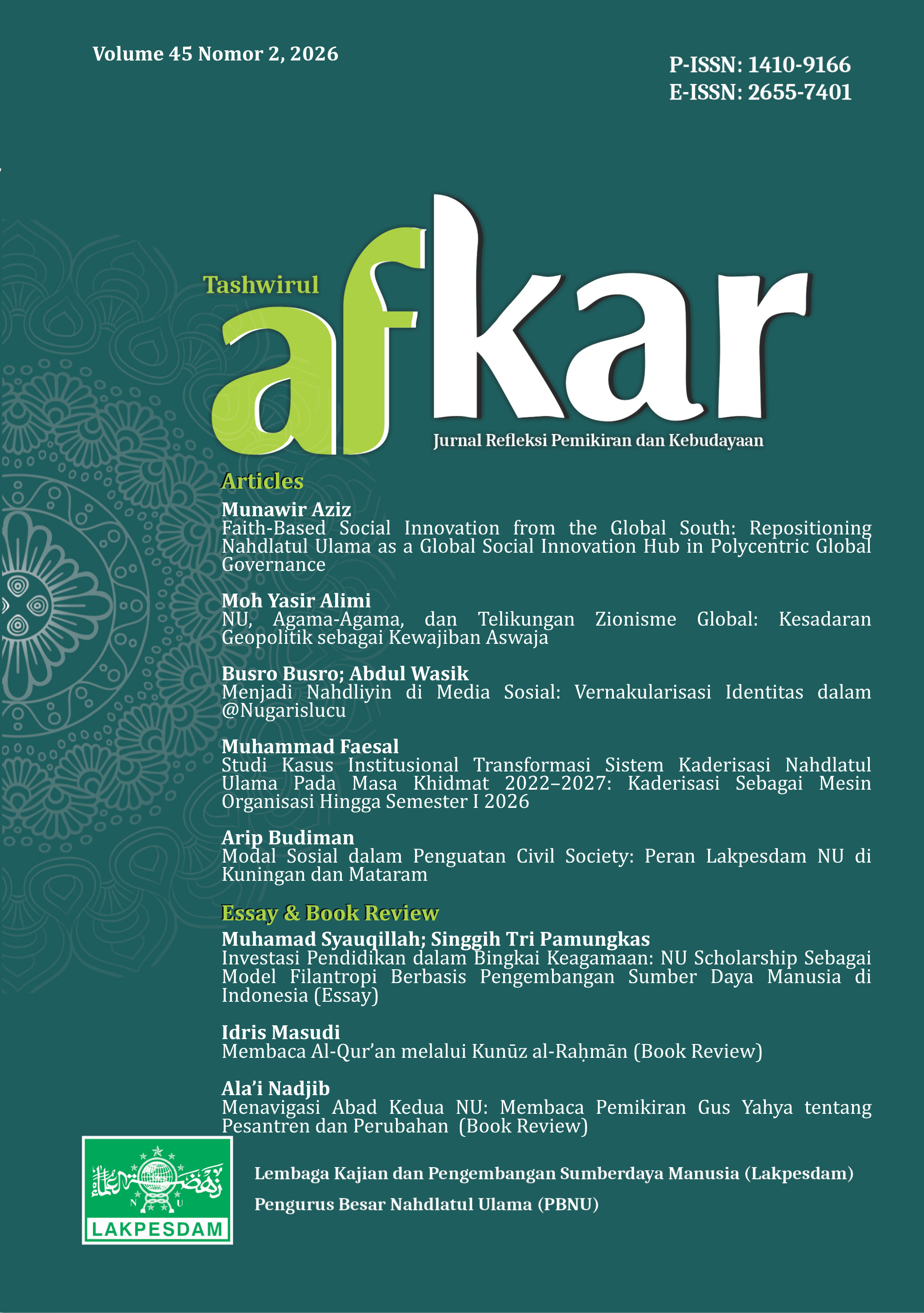
Modal Sosial dalam Penguatan Civil Society: Peran Lakpesdam NU di Kuningan dan Mataram Indonesia
##plugins.themes.bootstrap3.article.sidebar##
##plugins.themes.bootstrap3.article.main##
Abstract
This study examines the role of civil society organizations—Lakpesdam PCNU Kuningan and Lakpesdam PCNU Mataram—in fostering inclusive policies through the theoretical frameworks of social capital and community empowerment. Utilizing a qualitative comparative case study design with advocacy processes and civil society–community–state relations as the units of analysis, research data were drawn from a systematic selection of 18 primary corpus documents (Peduli program narrative reports, Monitoring Evaluation and Learning (MEL) documents, System of Verification (SoV) attachments, regional regulations, and secondary literature). The data were analyzed using qualitative content analysis with a combined deductive-inductive approach to identify the formation of social capital (bonding, bridging, and linking) in dismantling structural barriers faced by the Ahmadiyya community in Kuningan and Mataram. The findings identify three primary mechanisms underlying civil society effectiveness: (1) the mobilization of relational trust networks across religious, political, and bureaucratic actors; (2) strategic reframing of social exclusion as a citizenship rights issue rather than a theological debate; and (3) the cultivation of community self-reliance through participatory processes. This research contributes to civil society literature by demonstrating that social capital embedded within faith-based organizations can serve as a transformative resource for inclusive governance. Policy recommendations emphasize the institutionalization of civil society–state partnerships as a fundamental pillar for inclusive development strategies in Indonesia.
##plugins.themes.bootstrap3.article.details##

This work is licensed under a Creative Commons Attribution 4.0 International License.
References
Azhari, M. S., Dja’far, A. M., & Nugroho, A. S. (2014). Policy brief: Layanan adminduk bagi kelompok minoritas. The Wahid Institute.
Bradbury, H. (Ed.). (2015). The SAGE handbook of action research [Buku pegangan SAGE tentang penelitian tindakan] (3rd ed.). SAGE Publications.
Budiman, A. (2020). Sekularisasi dalam pertarungan simbolik: Studi konflik keagamaan Jemaat Ahmadiyah di Manislor Kuningan. Tashwirul Afkar, 38(1), 33–57.
Bush, R. (2009). Nahdlatul Ulama and the struggle for power within Islam and politics in Indonesia [Nahdlatul Ulama dan perebutan kekuasaan dalam Islam dan politik di Indonesia]. Institute of Southeast Asian Studies.
Chambers, R. (1994). The origins and practice of participatory rural appraisal [Asal-usul dan praktik pengkajian pedesaan partisipatif]. World Development, 22(7), 953–969.
Culpepper, P. D. (2010). Quiet politics and business power: Corporate control in Europe and Japan [Politik senyap dan kekuatan bisnis: Kontrol korporasi di Eropa dan Jepang]. Cambridge University Press.
Edwards, M. (2014). Civil society [Masyarakat sipil] (3rd ed.). Polity Press.
Fine, B. (2001). Social capital versus social theory: Political economy and social science at the turn of the millennium [Modal sosial versus teori sosial: Ekonomi politik dan ilmu sosial pada pergantian milenium]. Routledge. https://doi.org/10.4324/9780203470787
Freire, P. (1970). Pedagogy of the oppressed [Pedagogi kaum tertindas]. Herder and Herder.
Fuad, Z. (2019a). Laporan monitoring, evaluation, and learning (MEL) Program Peduli Lakpesdam PCNU Kabupaten Kuningan (2017–2019). Lakpesdam PBNU.
Fuad, Z. (2019b). Laporan narasi Program Peduli Lakpesdam PCNU Kabupaten Kuningan, Jawa Barat (2017–2019). Lakpesdam PBNU.
Habermas, J. (1991). The structural transformation of the public sphere: An inquiry into a category of bourgeois society [Transformasi struktural ruang publik: Penyelidikan atas kategori masyarakat borjuis] (T. Burger, Trans.). MIT Press.
Hefner, R. W. (2000). Civil Islam: Muslims and democratization in Indonesia [Islam sipil: Muslim dan demokratisasi di Indonesia]. Princeton University Press.
Hsieh, H.-F., & Shannon, S. E. (2005). Three approaches to qualitative content analysis [Tiga pendekatan dalam analisis isi kualitatif]. Qualitative Health Research, 15(9), 1277–1288.
Jayadi. (2019a). Laporan monitoring, evaluation, and learning (MEL) Program Peduli Lakpesdam PCNU Mataram, NTB (2017–2019). Lakpesdam PBNU.
Jayadi. (2019b). Laporan narasi Program Peduli Lakpesdam PCNU Mataram, NTB (2017–2019). Lakpesdam PBNU.
Kretzmann, J. P., & McKnight, J. L. (1993). Building communities from the inside out: A path toward finding and mobilizing a community’s assets [Membangun komunitas dari dalam: Jalan untuk menemukan dan menggerakkan aset komunitas]. Center for Urban Affairs and Policy Research, Northwestern University.
Lipsky, M. (2010). Street-level bureaucracy: Dilemmas of the individual in public services [Birokrasi tingkat jalanan: Dilema individu dalam pelayanan publik]. Russell Sage Foundation.
Mudzakkir, A. (2021). Rekognisi dan kewarganegaraan di Indonesia: Analisis terhadap Program Peduli Lakpesdam NU. Tashwirul Afkar, 40(2), 65–84.
Putnam, R. D. (2000). Bowling alone: The collapse and revival of American community [Bowling sendirian: Keruntuhan dan kebangkitan kembali komunitas Amerika]. Simon & Schuster.
Putnam, R. D., Leonardi, R., & Nanetti, R. Y. (1994). Making democracy work: Civic traditions in modern Italy [Membuat demokrasi bekerja: Tradisi kewargaan di Italia modern]. Princeton University Press.
Sen, A. (2000). Social exclusion: Concept, application, and scrutiny [Eksklusi sosial: Konsep, penerapan, dan telaah]. Asian Development Bank.
Topatimasang, R., Fakih, M., & Rahardjo, T. (Eds.). (2016). Mengubah kebijakan publik: Panduan pelatihan advokasi (Edisi ke-7). INSIST Press.
Turner, B. S. (Ed.). (2010). The New Blackwell companion to the sociology of religion [Pendamping New Blackwell untuk sosiologi agama]. Wiley-Blackwell. https://doi.org/10.1002/9781444320787
Ulfiah, U., & Budiman, A. (2021). Promosi inklusi sosial di Indonesia: Studi kasus pada organisasi masyarakat sipil di Kuningan Jawa Barat dan Bulukumba Sulawesi Selatan. SALAM: Jurnal Sosial dan Budaya Syar-i, 8(3), 851–866. https://doi.org/10.15408/sjsbs.v8i3.20939
Office of the United Nations High Commissioner for Human Rights. (2006). Frequently asked questions on a human rights-based approach to development cooperation [Pertanyaan yang sering diajukan tentang pendekatan berbasis hak asasi manusia dalam kerja sama pembangunan]. United Nations.
Warren, M. E. (2001). Democracy and association [Demokrasi dan asosiasi]. Princeton University Press. https://doi.org/10.2307/j.ctv1f886x8
Woolcock, M., & Narayan, D. (2000). Social capital: Implications for development theory, research, and policy [Modal sosial: Implikasi bagi teori pembangunan, penelitian, dan kebijakan]. The World Bank Research Observer, 15(2), 225–249.
Yin, R. K. (2018). Case study research and applications: Design and methods [Penelitian studi kasus dan aplikasinya: Desain dan metode] (6th ed.). SAGE Publications.