
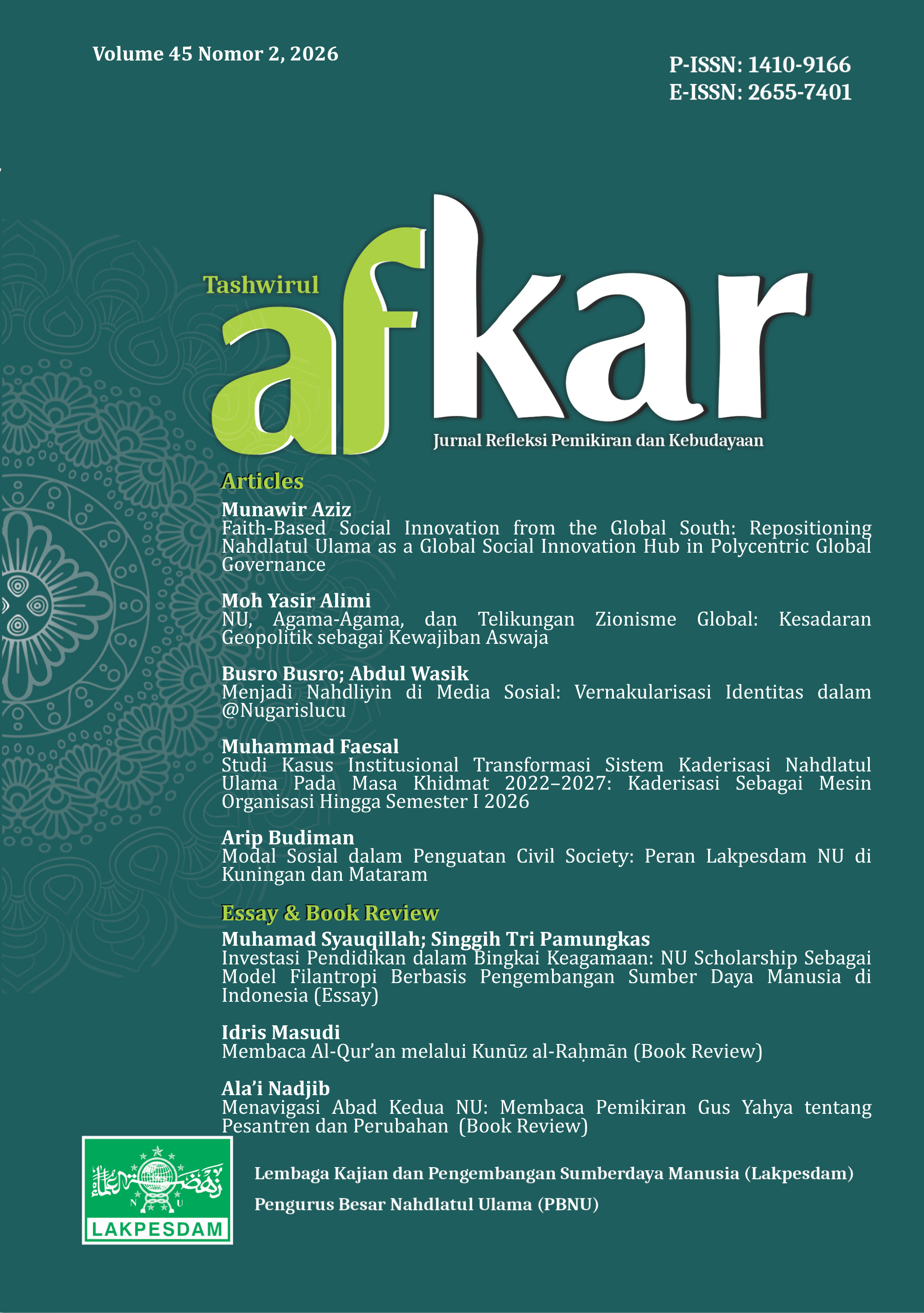
NU, Agama-Agama, dan Telikungan Zionisme Global: Kesadaran Geopolitik sebagai Kewajiban Aswaja
##plugins.themes.bootstrap3.article.sidebar##
##plugins.themes.bootstrap3.article.main##
Abstract
This article examines the position of Nahdlatul Ulama (NU) in the geopolitical struggle over narratives of Palestine, Islamophobia, and global Zionism. Taking as its point of departure the late Gus Im’s warning about the “entanglement of global capitalism,” the article argues that global Zionism operates not only through military power, state diplomacy, pro-Israel lobbying, and Western support, but also through the colonization of religious narratives. Islam is constructed as a threat; solidarity with Palestine is suspected as extremism; criticism of Israel is equated with antisemitism; and religious moderation is redirected into a soft—indeed silent—posture in the face of colonialism and genocide. The article examines the post-Cold War securitization of Islam, hasbara, the normalization of violence in Gaza and Lebanon, the demonization of Iran, Christian Zionism, Sunni-Shi‘a sectarianization, and the internalization of epistemic Islamophobia within Muslim communities themselves. Its central argument is that NU must reclaim Aswaja as an ethic of justice, geopolitical consciousness, anticolonial responsibility, and defense of the mustad‘afin—not as a brand of moderation that is safe for an unequal global order. Aswaja rahmatan lil ’alamin must be distinguished from imperial moderation: the former defends victims, while the latter normalizes settler colonialism, apartheid, blockade, and genocide. The article also argues that defending Palestine is not a departure from NU’s history, but a continuation of the geopolitical instinct of its founding scholars, who since 1938 had already made Palestine part of Islamic, communal, and anticolonial consciousness.
##plugins.themes.bootstrap3.article.details##

This work is licensed under a Creative Commons Attribution 4.0 International License.
References
Magazine. (2026, June 26). Why “ungrounding” is the defining feature of Israel’s genocide. https://www.972mag.com/podcast-eyal-weizman-ungrounding-gaza-genocide/
The Arab Center for the Advancement of Social Media. (2024, January 17). Hashtag Palestine 2023: Palestinian digital rights during war.
Amnesty International. (2022). Israel’s apartheid against Palestinians: Cruel system of domination and crime against humanity (Index No. MDE 15/5141/2022).
Aouragh, M. (2016). Hasbara 2.0: Israel’s public diplomacy in the digital age. Middle East Critique. https://doi.org/10.1080/19436149.2016.1179432
Aouragh, M. (2026). Digital illusions, political delusions: Israel’s hasbara propaganda revisited in a time of genocide. Third World Quarterly, 47(10), 2022–2047. https://doi.org/10.1080/01436597.2026.2619061
Ariel, Y. (2006). An unexpected alliance: Christian Zionism and its historical significance. Modern Judaism, 26(1), 74–100. https://doi.org/10.1093/mj/kjj001
B’Tselem. (2021). A regime of Jewish supremacy from the Jordan River to the Mediterranean Sea: This is apartheid. B’Tselem.
Banu, U. A. B. R. A. (1993). Fundamentalist Islam: A threat to the West? Islamic Studies, 32(1), 113–125.
Benard, C. (2004). Civil democratic Islam: Partners, resources, and strategies. RAND Corporation.
Bouchat, C. J. (1996). A fundamentalist Islamic threat to the West. Studies in Conflict & Terrorism, 19(4), 339–352.
Boyer, P. (1992). When time shall be no more: Prophecy belief in modern American culture. Harvard University Press.
Bush, A. F. (2009). The implications of Christian Zionism for mission. International Bulletin of Missionary Research, 33(3), 144–150. https://doi.org/10.1177/239693930903300305
Conforti, Y. (2024). Zionism and the Hebrew Bible: From religious holiness to national sanctity. Middle Eastern Studies, 60(3), 483–497. https://doi.org/10.1080/00263206.2023.2246231
Dale, W. (2004). The impact of Christian Zionism on American policy. American Diplomacy, 9(2).
Deliso, C. (2007). The coming Balkan caliphate: The threat of radical Islam to Europe and the West. Praeger Security International.
Durbin, S. (2013). “I will bless those who bless you”: Christian Zionism, fetishism, and unleashing the blessings of God. Journal of Contemporary Religion, 28(3), 507–521. https://doi.org/10.1080/13537903.2013.831667
Durbin, S. (2014). Christian Zionism in the United States, 1930–2020 [Doctoral dissertation/open access dissertation].
Euro-Med Human Rights Monitor. (2023, November 29). Int’l committee must be formed to investigate Israeli army’s abandonment of five infants, now dead, alone in Gaza hospital.
Einstein, A., Arendt, H., Hook, S., et al. (1948, December 4). New Palestine Party: Visit of Menachem Begin and aims of political movement discussed. The New York Times, p. 12.
Erakat, N., Li, D., & Reynolds, J. (2023). Race, Palestine, and international law. AJIL Unbound, 117, 77–81. https://doi.org/10.1017/aju.2023.9
Falk, R., & Tilley, V. (2017). Israeli practices towards the Palestinian people and the question of apartheid (Palestine and the Israeli Occupation, Issue No. 1, E/ESCWA/ECRI/2017/1). United Nations Economic and Social Commission for Western Asia.
Finney, M. (2016). Christian Zionism, the US, and the Middle East: A sketch and brief analysis. In M. J. Sandford (Ed.), The Bible, Zionism, and Palestine: The Bible’s role in conflict and liberation in Israel-Palestine (pp. 20–31). Relegere Academic Press.
Forensic Architecture. (2024). A cartography of genocide: Israel’s conduct in Gaza since October 2023. Goldsmiths, University of London. https://forensic-architecture.org/investigation/a-cartography-of-genocide
Gause, F. G., III. (2014). Beyond sectarianism: The new Middle East Cold War. Brookings Doha Center.
Goldman, S. (2007). Christians and Zionism: A review essay. American Jewish History, 93(2), 245–260. https://doi.org/10.1353/ajh.2007.0022
Gur-Ze’ev, I., & Pappé, I. (2003). Beyond the destruction of the other’s collective memory. Theory, Culture & Society, 20(1), 93–108.
Haddad, H. S. (1974). The biblical bases of Zionist colonialism. Journal of Palestine Studies, 3(4), 97–113. https://doi.org/10.2307/2535451
Hashemi, N., & Postel, D. (Eds.). (2017). Sectarianization: Mapping the new politics of the Middle East. Oxford University Press.
Human Rights Watch. (2021, April 27). A threshold crossed: Israeli authorities and the crimes of apartheid and persecution.
Human Rights Watch. (2023, December 21). Meta’s broken promises: Systemic censorship of Palestine content on Instagram and Facebook.
Human Rights Watch. (2024, June 5). Lebanon: Israel’s white phosphorus use risks civilian harm.
Human Rights Watch. (2026, March 9). Lebanon: Israel unlawfully using white phosphorus.
Huntington, S. P. (1993). The clash of civilizations? Foreign Affairs, 72(3), 22–49.
Huntington, S. P. (1996). The clash of civilizations and the remaking of world order. Simon & Schuster.
International Court of Justice. (2024, January 26). Application of the Convention on the Prevention and Punishment of the Crime of Genocide in the Gaza Strip (South Africa v. Israel): Order of 26 January 2024.
Jędrzejewska, K. (2020). Hasbara: Public diplomacy with Israeli characteristics. Toruń International Studies. https://doi.org/10.12775/TIS.2020.008
Lewis, D. M. (2014). The origins of Christian Zionism: Lord Shaftesbury and evangelical support for a Jewish homeland. Cambridge University Press.
Mamdani, M. (2004). Good Muslim, bad Muslim: America, the Cold War, and the roots of terror. Pantheon Books.
Masalha, N. (2009). Reading the Bible with the eyes of the Canaanites: Neo-Zionism, political theology and the land traditions of the Bible (1967 to Gaza 2009). Holy Land Studies, 8(1), 55–108. https://doi.org/10.3366/E147494750900032X
McAlister, M. (2005). Epic encounters: Culture, media, and U.S. interests in the Middle East since 1945 (Updated ed.). University of California Press.
McDoom, O. S. (2026). It’s Hamas’ fault, you’re an antisemite, and we had no choice: Techniques of genocide denial in Gaza. Journal of Genocide Research, 28(3), 615–632. https://doi.org/10.1080/14623528.2025.2556582
Merkley, P. C. (1998). The politics of Christian Zionism, 1891–1948. Frank Cass.
Pappé, I. (2006b). The ethnic cleansing of Palestine. Oneworld.
Pappé, I. (2008). Zionism as colonialism: A comparative view of diluted colonialism in Asia and Africa. South Atlantic Quarterly, 107(4), 611–633.
Pappé, I. (2009). De-terrorising the Palestinian national struggle: The roadmap to peace. Critical Studies on Terrorism, 2(2), 127–146. https://doi.org/10.1080/17539150903021399
Pappé, I. (2012). Shtetl colonialism: First and last impressions of indigeneity by colonised colonisers. Settler Colonial Studies, 2(1), 39–58.
Pappé, I. (2016). The Bible in the service of Zionism: “We do not believe in God, but he nonetheless promised us Palestine.” In I. Hjelm & T. L. Thompson (Eds.), History, archaeology and the Bible forty years after “historicity” (pp. 205–217). Routledge. https://doi.org/10.4324/9781315690780-16
Pappé, I. (2017). The biggest prison on earth: A history of the occupied territories. Oneworld.
Pappé, I. (2020). An indicative archive: Salvaging Nakba documents. Journal of Palestine Studies, 49(3), 22–40. https://doi.org/10.1525/jps.2020.49.3.22
Pappé, I. (2024b). A very short history of the Israel–Palestine conflict. Oneworld.
Pappé, I., Dana, T., & Naser-Najjab, N. (2024). Palestine Studies, knowledge production, and the struggle for decolonisation. Middle East Critique, 33(2), 173–193. https://doi.org/10.1080/19436149.2024.2342189
Phillips, M. (2006). Londonistan: How Britain is creating a terror state within. Gibson Square.
Rabasa, A., Benard, C., Schwartz, L. H., & Sickle, P. (2007). Building moderate Muslim networks. RAND Corporation. https://doi.org/10.7249/MG574
Rood, J. M., & Rood, P. W. (2011). Is Christian Zionism based on bad theology? Cultural Encounters, 7(1), 37–48.
Russell, W. F. (2013). Islam: A threat to civilization. First Edition Design Publishing.
Sabel, R. (2017). Review of Israel’s public diplomacy: The problems of hasbara, 1966–1975, by J. Cummings. Israel Journal of Foreign Affairs. https://doi.org/10.1080/23739770.2017.1287249
Said, E. W. (1978). Orientalism. Pantheon Books.
Said, E. W. (1979). The question of Palestine. Times Books.
Said, E. W. (1997). Covering Islam: How the media and the experts determine how we see the rest of the world. Vintage.
Schleifer, R. (2003). Jewish and contemporary origins of Israeli hasbara. Jewish Political Studies Review, 15(1/2), 123–153.
Sela, R. (2021). Resilient resistance: Colonial biblical, archaeological and ethnographical imaginaries in the work of Chalil Raad (Khalīl Raʿd), 1891–1948. In Imaging and imagining Palestine (pp. 185–226). Brill.
Setiawan, M. B. (2023, October 9). Jejak kepedulian NU terhadap masalah Palestina. Hidayatullah.com.
Shapiro, F. L. (2015). Christian Zionism: Navigating the Jewish-Christian border. Wipf and Stock.
Sizer, S. (2004). Christian Zionism: Road-map to Armageddon? InterVarsity Press.
Sizer, S. (2010). The Bible and Christian Zionism: Roadmap to Armageddon? Transformation, 27(2), 122–132. https://doi.org/10.1177/0265378810362541
The Lancet. (2025). Gaza: A moral and public health crisis. The Lancet, 406, 542.
Tweissi, B. (2024). How Israel lost the 2023 Gaza propaganda war. Al-Muntaqa: New Perspectives on Arab Studies, 7(1), 127–141.
United Nations Office of the High Commissioner for Human Rights. (2025, September 16). Israel has committed genocide in the Gaza Strip, UN Commission finds. Office of the United Nations High Commissioner for Human Rights.
United Nations Office of the High Commissioner for Human Rights. (2026, June). Israel continues to commit genocide and other atrocity crimes by deliberately targeting Palestinian children, UN Commission finds. Office of the United Nations High Commissioner for Human Rights.
Wahid, H. (1999). Telikungan kapitalisme global. FKGMNU.
Weber, T. P. (2004). On the road to Armageddon: How evangelicals became Israel’s best friend. Baker Academic.
Weizman, E. (2026). Ungrounding: The architecture of genocide. Fern Press.
Wolfe, P. (2006). Settler colonialism and the elimination of the native. Journal of Genocide Research, 8(4), 387–409.
Yiftachel, O. (2009). “Creeping apartheid” in Israel-Palestine. Middle East Report, 253, 7–15, 37.
Zidni, E., & Zahroh, E. S. (2023). Analisis konsistensi Nahdlatul Ulama (NU) mendorong kemerdekaan Palestina. Islam Nusantara: Journal for the Study of Islamic History and Culture, 4(1), 55–81.
Zuhri, S. (1948). Palestina dari zaman ke zaman. PBNU Bagian Penerbitan dan Penyiaran.