
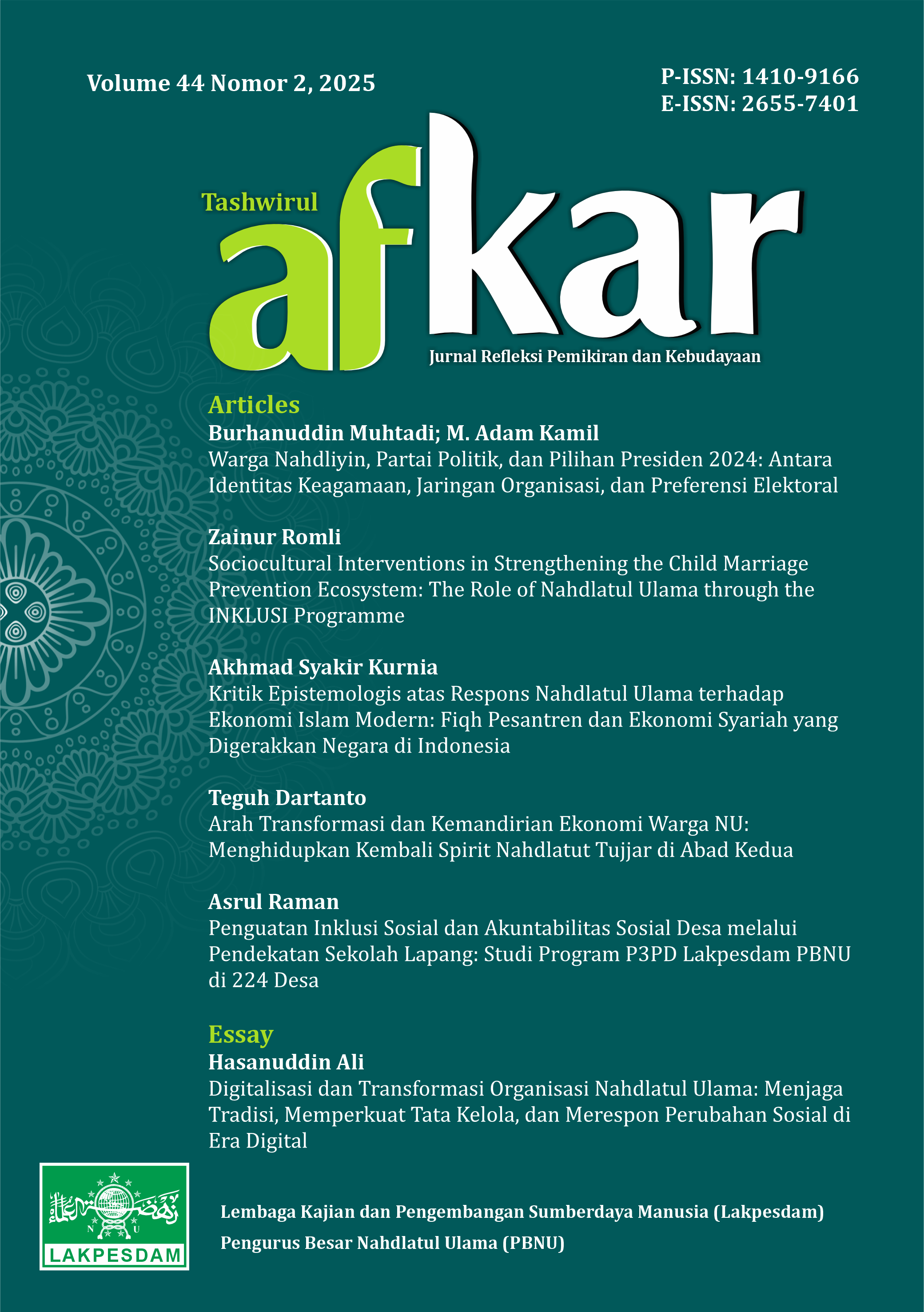
Arah Transformasi dan Kemandirian Ekonomi Warga NU: Menghidupkan Kembali Spirit Nahdlatut Tujjar di Abad Kedua
##plugins.themes.bootstrap3.article.sidebar##
##plugins.themes.bootstrap3.article.main##
Abstract
Nahdlatut Tujjar sebagai embrio gerakan ekonomi NU menegaskan bahwa kemandirian ekonomi sejak awal merupakan bagian integral dari perjuangan keagamaan dan sosial NU. Namun, dalam perjalanan sejarah, agenda ekonomi jamaah mengalami pasang surut, sementara struktur ekonomi nasional berkembang dengan cepat, bias dan kurang inklusif terhadap usaha kecil dan sektor informal—ruang utama kehidupan ekonomi warga NU. Kerentanan ekonomi warga NU bersifat struktural, bukan akibat defisit etos atau aspirasi, melainkan refleksi dari keterbatasan akses terhadap modal, pasar, dan kapasitas usaha dalam arsitektur ekonomi yang belum inklusif. Meskipun NU merupakan economic majority dengan potensi konsumsi yang sangat besar, ekonomi jamaah masih didominasi oleh usaha mikro dan informal yang beroperasi dalam logika bertahan hidup, sehingga menimbulkan paradoks antara besarnya peran sosial keagamaan dan lemahnya proses tumbuh dan kenaikan kelas skala usaha. Sebagai sintesis, tulisan ini mengajukan kerangka pengembangan ekonomi jamaah NU berbasis 3M—money, market, dan mindset sebagai diagnosis inti dan arah transformasi bertahap berbasis ekosistem, dengan menempatkan jamaah sebagai subjek, memperkuat peran pesantren dan kelembagaan NU, serta mendorong pergeseran NU dari penerima program menjadi aktor kebijakan. Kemandirian ekonomi jamaah diposisikan sebagai prasyarat keberlanjutan NU sebagai jam’iyah sosial-keagamaan di abad kedua.
##plugins.themes.bootstrap3.article.details##

This work is licensed under a Creative Commons Attribution 4.0 International License.
References
Ansell, C., & Gash, A. (2007). Collaborative Governance in Theory and Practice. Journal of Public Administration Research and Theory, 18(4), 543–571. https://doi.org/10.1093/jopart/mum032
Arifianto, A. R. (2017). Practicing What It Preaches? Understanding the Contradictions between Pluralist Theology and Religious Intolerance within Indonesia’s Nahdlatul Ulama. Al-Jami’ah: Journal of Islamic Studies, 55(2), 241–264. https://doi.org/10.14421/ajis.2017.552.241-264
Armendáriz, B., & Morduch, J. (2007). The Economics of Microfinance (2nd ed.). MIT Press.
Arodha, D., Panorama, M., Moh. Syawaludin, & Musari, K. (2025). Can Muslim Communities Empower through Ethnic-based? A Case Study in Indonesia. International Journal of Islamic Khazanah, 15(1), 36–47. https://doi.org/10.15575/ijik.v15i1.48990
Asmawi, A. (2023). Murūnah Ijtihād Jam‘Iyyah Nahḍah Al-‘Ulama: Min Fiqh al-Ḥaḍārah ilā Dīn al-‘Ishrīn. Journal Of Indonesian Islam, 17(1), 213. https://doi.org/10.15642/JIIS.2023.17.1.213-237
Badan Pusat Statistik. (2024). Keadaan Ketenagakerjaan Indonesia 2023.
Banerjee, A. V, & Duflo, E. (2011). Poor Economics: A Radical Rethinking of the Way to Fight Global Poverty. PublicAffairs.
Banerjee, A. V, & Newman, A. F. (1993). Occupational Choice and the Process of Development. Journal of Political Economy, 101(2), 274–298. https://doi.org/10.1086/261876
Birchall, J. (2011). People-Centred Businesses: Co-operatives, Mutuals and the Idea of Membership. Palgrave Macmillan. https://doi.org/10.1057/9780230295292
Booth, A. (1998). The Indonesian Economy in the Nineteenth and Twentieth Centuries: A History of Missed Opportunities. Macmillan. https://doi.org/10.1057/9780333994962
BPS. (2025). Tingkat Pengangguran Terbuka (TPT) sebesar 4,76 persen. Rata–rata upah buruh sebesar 3,09 juta rupiah. Badan Pusat Statistik. https://www.bps.go.id/id/pressrelease/2025/05/05/2432/tingkat-pengangguran-terbuka--tpt--sebesar-4-76-persen--rata-rata-upah-buruh-sebesar-3-09-juta-rupiah-.html?utm_source=chatgpt.com
Budiatri, A. P. (2025). Dynamic Tolerance: Tolerance within Nahdlatul Ulama and Nahdliyin in Indonesia. TRaNS: Trans -Regional and -National Studies of Southeast Asia, 13(2), 247–263. https://doi.org/10.1017/trn.2025.2
Bush, R. (2009). Nahdlatul Ulama and the Struggle for Power within Islam and Politics in Indonesia. ISEAS Publishing. https://doi.org/10.1355/9789812308795
Chang, H.-J. (2002). Kicking Away the Ladder: Development Strategy in Historical Perspective. Anthem Press.
Chen, M. A. (2012). The Informal Economy: Definitions, Theories and Policies (Issue Working Paper No. 1).
Dartanto, T. (2023). Strategi dan implementasi penguatan ekonomi jamaah memasuki abad kedua Nahdlatul Ulama. Sarasehan Ekonomi Nahdlatul Ulama.
De Soto, H. (2003). The Mystery of Capital: Why Capitalism Triumphs in the West and Fails Everywhere Else. Basic Books.
Dhofier, Z. (1982). Tradisi Pesantren: Studi tentang Pandangan Hidup Kiai. LP3ES.
Evans, P. (1995). Embedded Autonomy: States and Industrial Transformation. Princeton University Press. https://doi.org/10.1515/9781400821723
Fealy, G. (1998). Ulama and Politics in Indonesia: A History of Nahdlatul Ulama, 1952--1967. Monash Asia Institute.
Fealy, G. (2008). The political contingency of reformmindedness in Indonesia’s Nahdlatul Ulama: Interest politics and the Khittah. In Islamic Legitimacy in a Plural Asia (pp. 154–166). https://doi.org/10.4324/9780203933404-16
Grimm, M., Knorringa, P., & Lay, J. (2012). Constrained Gazelles: High Potentials in West Africa’s Informal Economy. World Development, 40(7), 1352–1368. https://doi.org/10.1016/j.worlddev.2012.03.009
Grindle, M. S. (2017). Politics and Policy Implementation in the Third World (Vol. 4880). Princeton University Press.
Hamdi, A. Z. (2021). Constructing Indonesian Religious Pluralism: The Role of Nahdlatul Ulama in Countering Violent Religious Extremism. Journal of Indonesian Islam, 15(2), 433. https://doi.org/10.15642/JIIS.2021.15.2.433-464
Harriss-White, B. (2010). Work and Wellbeing in Informal Economies: The Regulative Roles of Institutions. Routledge. https://doi.org/10.1016/j.worlddev.2009.10.011
International Labour Organization. (2022). Indonesia Decent Work Country Programme 2020--2025.
International Labour Organization. (2025). The ILO in Indonesia. International Labour Organization. https://www.ilo.org/sites/default/files/2025-04/Country brochure_The ILO in indonesia.pdf
Kabeer, N. (2015). Gender, Poverty, and Inequality: A Brief History of Feminist Contributions in the Field of International Development. Feminist Economics, 21(3), 1–26. https://doi.org/10.1080/13545701.2015.1062300
Lakpesdam. (2023). EXECUTIVE SUMMARY: Survei Potret dan Harapan Warga Nahdlatul Ulama. https://www.lakpesdam.or.id/wp-content/uploads/2023/09/Executive-Summary-Potret-Warga-NU-2.0.pdf
Leftwich, A. (2009). Bringing Agency Back In: Politics and Human Agency in Building Institutions and States.
Lewis, W. A. (1954). Economic Development with Unlimited Supplies of Labour. The Manchester School, 22(2), 139–191. https://doi.org/10.1111/j.1467-9957.1954.tb00021.x
Maftuhin, A. (2021). Mosques for All: Nahdlatul Ulama and the Promotion of the Rights of People with Disabilities. Journal of Indonesian Islam, 15(2), 247. https://doi.org/10.15642/JIIS.2021.15.2.247-270
Maghfiroh, M., Iryani, E., Haerudin, H., Yani, M. T., Zaini, N., & Mahfud, C. (2024). Promoting Green Pesantren: Change, Challenge and Contribution of Nahdlatul Ulama in Indonesia. Nazhruna: Jurnal Pendidikan Islam, 7(2), 409–435. https://doi.org/10.31538/nzh.v7i2.4668
Mazzucato, M. (2024). The Entrepreneurial State: Debunking Public vs. Private Sector Myths. Penguin.
McKenzie, D., & Woodruff, C. (2014). What Are We Learning from Business Training and Entrepreneurship Evaluations Around the Developing World? World Bank Research Observer, 29(1), 48–82. https://doi.org/10.1093/wbro/lkt007
Mietzner, M., & Muhtadi, B. (2020). The Myth of Pluralism: Nahdlatul Ulama and the Politics of Religious Tolerance in Indonesia. Contemporary Southeast Asia: A Journal of International and Strategic Affairs, 42(1), 58–84. https://doi.org/10.1355/cs42-1c
North, D. C. (1990). Institutions, Institutional Change and Economic Performance. Cambridge University Press. https://doi.org/10.1017/CBO9780511808678
NU Online. (2003). Nahdlatut Tujjar sebagai Embrio NU. https://www.nu.or.id/warta/nahdlatut-tujjar-sebagai-embrio-nu-9mvC4
NU Online. (2025). Resmikan Bisnis Center di Hari Santri 2025, Ikhtiar PCNU Kota Bandung Wujudkan Kemandirian Organisasi. NU Online Jabar. https://jabar.nu.or.id/kota-bandung/resmikan-bisnis-center-di-hari-santri-2025-ikhtiar-pcnu-kota-bandung-wujudkan-kemandirian-organisasi-36G6x
Rahman, F. (2017). Wasiat KH Hasyim Asy’ari tentang Kemandirian Ekonomi. https://nu.or.id/fragmen/wasiat-kh-hasyim-asy-ari-tentang-kemandirian-ekonomi-ixymp
Ray, D. (2006). Aspirations, Poverty, and Economic Change. In A. V Banerjee, R. Bénabou, & D. Mookherjee (Eds.), Understanding Poverty (pp. 409–421). Oxford University Press. https://doi.org/10.1093/0195305191.003.0028
Ricklefs, M. C. (2001). A History of modern Indonesia since c.1200. Palgrave.
Rodrik, D. (2016). Premature Deindustrialization. Journal of Economic Growth, 21(1), 1–33. https://doi.org/10.1007/s10887-015-9122-3
Rostow, W. W. (1960). The Stages of Economic Growth: A Non-Communist Manifesto. Cambridge University Press.
Scott, J. C. (1976). The Moral Economy of the Peasant: Rebellion and Subsistence in Southeast Asia. Yale University Press.
Steenbrink, K. (1986). Pesantren, Madrasah, Sekolah: Pendidikan Islam dalam Kurun Modern. LP3ES.
Stiglitz, J. E. (2012). The Price of Inequality: How Today’s Divided Society Endangers Our Future. W. W. Norton & Company.
Subchi, F. (2017). NU, Ekonomi, dan Politik Kemaslahatan. https://www.nu.or.id/opini/nu-ekonomi-dan-politik-kemaslahatan-WMUyo
Thompson, E. P. (1971). The Moral Economy of the English Crowd in the Eighteenth Century. Past & Present, 50, 76–136. https://doi.org/10.1093/past/50.1.76
van Bruinessen, M. (1994). Traditions for the Future: The Reconstruction of Traditionalist Discourse within NU. In G. Barton & G. Fealy (Eds.), Nahdlatul Ulama, Traditional Islam and Modernity in Indonesia (pp. 99–130). Monash Asia Institute.
Wadipalapa, R. (2021). Countering the Communist Imaginary: The Role of Nahdlatul Ulama in Indonesia’s 2014 and 2019 Presidential Elections. Contemporary Southeast Asia, 43(3), 557–584. https://doi.org/10.1355/cs43-3e
Woolcock, M., & Narayan, D. (2000). Social Capital: Implications for Development Theory, Research, and Policy. The World Bank Research Observer, 15(2), 225–249. https://doi.org/10.1093/wbro/15.2.225
World Bank. (2019). World Development Report 2019: The Changing Nature of Work.