
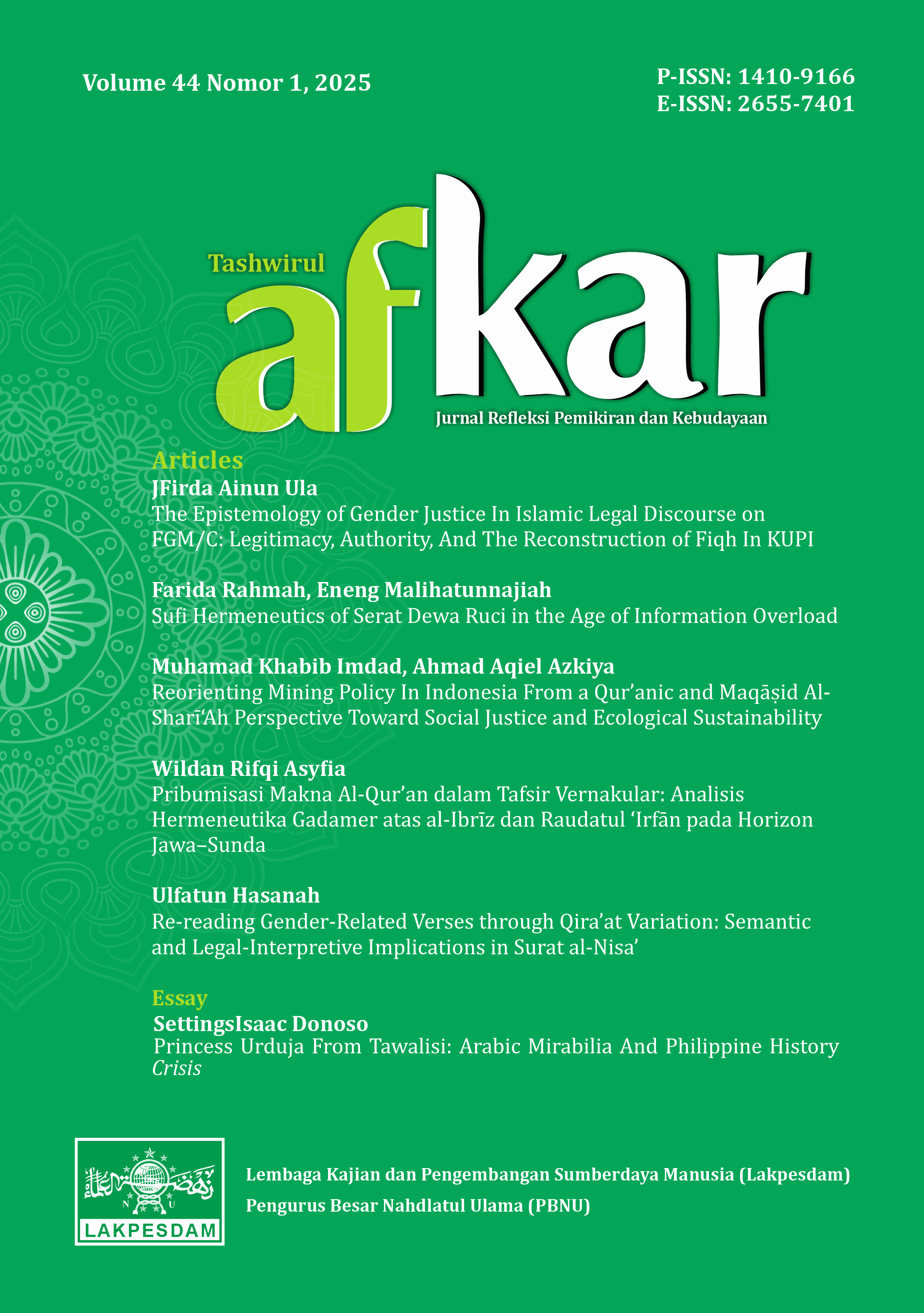
Sufi Hermeneutics of Serat Dewa Ruci in the Age of Information Overload
##plugins.themes.bootstrap3.article.sidebar##
##plugins.themes.bootstrap3.article.main##
Abstract
This study aims to reinterpret Serat Dewa Ruci as a symbolic-spiritual text that is relevant to understanding contemporary problems of digital literacy, particularly in situations of information overload, misinformation, and post-truth. The study is significant because scholarship on Serat Dewa Ruci, Islamic Sufism, and digital literacy has largely developed in separate directions, with few integrative readings that bring these three domains into a single analytical framework. This research employs a qualitative library-based approach, with Serat Dewa Ruci as the primary unit of analysis. Data were collected through documentary study of primary and secondary sources and were analysed using hermeneutic and semiotic approaches in order to interpret the text’s symbolic structure, spiritual meaning, and contextual relevance. The findings show that Bima’s journey is constructed as a symbolic progression from outward searching to inward disclosure, while his encounter with Dewa Ruci forms an epistemic discipline that emphasises humility, inward deepening, the ability to interpret signs, and ethical readiness in receiving truth. In the contemporary context, this symbolic structure has strong relevance for strengthening digital literacy, as it offers a model of knowledge grounded in caution, verification, clarity of interpretation, and ethical responsibility. The implication of this study is that digital literacy should be developed not merely as a technical competence, but also as a hermeneutic, ethical, and spiritual practice. The originality of this research lies in its effort to bring together Serat Dewa Ruci as a text of Javanese culture, Islamic Sufism as a spiritual-epistemic framework, and digital literacy as a contemporary problem of knowledge within a single integrative reading.
##plugins.themes.bootstrap3.article.details##

This work is licensed under a Creative Commons Attribution 4.0 International License.
References
Adi, D. (2023a) ‘Analysis of Application of UTAUT2 Model in GO-PAY Usage Adoption through Digital Transaction among Millennial Generation and Z Generation in Semarang City, Central Java, Indonesia’, in E3S Web of Conferences. Available at: https://doi.org/10.1051/e3sconf/202342602084.
Adi, D. (2023b) ‘Dewa Ruci Graphic Narrative Adaptation: Popular Media to Introduce Classical Wayang Mythology and Alternative Character Education Content for Generation Z’, in E3S Web of Conferences. Available at: https://doi.org/10.1051/e3sconf/202342602026.
Adi, D. and Mustafa, M. (2025) IntegratingComics as a Practical Learning Tool to Improve Comprehension:A Case Study of Wayang Comic in Delivering Character Education Content, New Media Applications in Digital Education. Available at: https://doi.org/10.4018/979-8-3373-5157-5.ch003.
Aulia, R.N. et al. (2024) ‘Eco-pesantren modeling for environmentally friendly behavior: new lessons from Indonesia’, International Journal of Evaluation and Research in Education, 13(1), pp. 223 – 229. Available at: https://doi.org/10.11591/ijere.v13i1.25930.
Corak, M. (2013) ‘Income inequality, equality of opportunity, and intergenerational mobility’, Journal of Economics Perspektives, 27(3), pp. 79–102. Available at: https://doi.org/10.1257/jep.27.3.79.
Creswell (2013) Research Design Pendekatan Kualitatif, Kuantitatif. Yogyakarta: Pustaka Pelajar.
Floridi, L. (2016) ‘Information overload, why it matters and how to combat it’, Philosophical Transactions of the Royal Society A, 374(2083), p. 20160162.
Horngren, C.T., Datar, S.M. and Foster, G.M. (2008) Akuntansi biaya: Dengan penekanan manajerial. Dialih bahasakan oleh P. A. Lestari. 12th edn. Jakarta: Erlangga.
Koentjaraningrat (1994) Javanese Culture. Balai Pustaka.
Murti, D.K., Gunarhadi and Winarno (2020) ‘Development of Educational Comic with Local Wisdom to Foster Morality of Elementary School Students: A Need Analysis’, International Journal of Educational Methodology, 6(2), pp. 337 – 343. Available at: https://doi.org/10.12973/ijem.6.2.337.
Nasr, S.H. (1989) Knowledge and the Sacred. SUNY Press.
Nasuhi, H. (2009) Serat Dewaruci: Javanese Sufism Yasadipura I. Ushul Press.
Padnobo, H.C. (2023) ‘The Dewa Ruci play as a manifestation of the individual human journey to meet God’, Lakon: Journal of Wayang Study and Creation [Preprint].
Pariser, E. (2011) The Filter Bubble: What the Internet Is Hiding from You. Penguin Press.
Rahayu, E.S. (2020) ‘Perfect Islam in the concept of sharia, sufi order, and reality’, Emanasi Journal, 3(1).
Siswoharsojo, K. (1996) Interpretation of the Book of Dewarutji. PT Loker.
UNESCO (2011) Media and Information Literacy Curriculum for Teachers. United Nations Educational, Scientific and Cultural Organization.
Wardhana, A.F.G. (2023) ‘Authority Sharing Between the Central and Regional Government in The Implementation of Pesantrens Law and Its Relevance to Hifdz al-Dîn Efforts’, Al-’Adalah, 20(1), pp. 91 – 114. Available at: https://doi.org/10.24042/adalah.v20i1.16080.
Wardle, C. and Derakhshan, H. (2017) Information Disorder: Toward an Interdisciplinary Framework for Research and Policy Making. Council of Europe.