
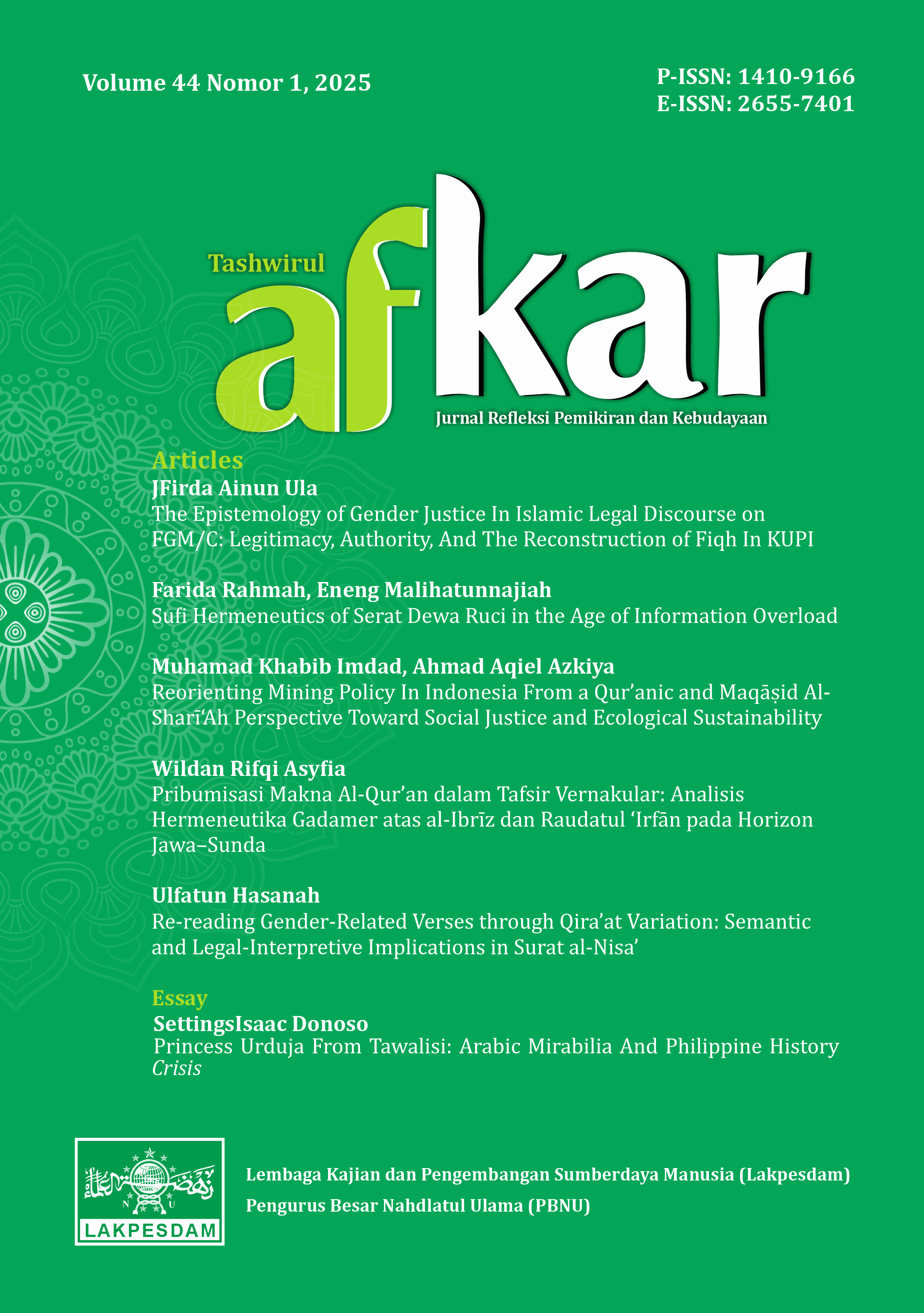
Re-reading Gender-Related Verses through Qira’at Variation: Semantic and Legal-Interpretive Implications in Surat al-Nisa’
##plugins.themes.bootstrap3.article.sidebar##
##plugins.themes.bootstrap3.article.main##
Abstract
This article examines how qira’at variation in selected gender-related verses of Surat al-Nisa’ shapes semantic expansion and legal-interpreive consequences in Qur’anic exegesis. The study is motivated by the persistence of monolithic readings of gender verses in contemporary Muslim discourse, particularly on issues such as polygamy, violence against women, household authority, and bodily contact in ritual contexts. Using a qualitative library research design, this article employs a Qur’anic exegesis approach with particular attention to thematic tafsir and qira’at analysis. The unit of analysis consists of variant readings in Q. al-Nisa’ 4:3, 4:19, 4:34, and 4:43. Primary data are drawn from the relevant Qur’anic verses, classical qira’at works, and tafsir literature, while secondary data are taken from scholarly studies on gender-related Qur’anic interpretation. The data are analyzed through comparative-textual and interpretive analysis. The study finds, first, that qira’at variation produces semantic expansion by opening broader lexical, relational, and ethical possibilities in gender-related verses. Second, these semantic differences generate distinct legal-interpreive consequences, including stricter readings of polygamy, broader protections against violence toward women, more reciprocal understandings of household responsibility, and plural ritual-legal rulings concerning bodily contact. Third, these findings support a re-reading of gender verses beyond a monolithic Hafs-based interpretive framework. This article argues that qira’at plurality should be treated not as a peripheral technical issue, but as an internal methodological resource for more dialogical, contextual, and textually grounded gender-sensitive Qur’anic interpretation.
##plugins.themes.bootstrap3.article.details##

This work is licensed under a Creative Commons Attribution 4.0 International License.
References
Boulaouali, Tijani. 2021. “Quran Translation: A Historical-Theological Exploration.” International Journal of Islamic Thought 19(1): 120–32. doi:10.24035/ijit.19.2021.202.
Daneshgar, M, P G Riddell, and A Rippin. 2016. The Qur’ān in the Malay-Indonesian World: Context and Interpretation The Qur’ān in the Malay-Indonesian World: Context and Interpretation. doi:10.4324/9781315646350.
Farhan, Khaleel Owain. 2025. “Las Obras Exegéticas y El Dominio Lingüístico: Herramientas Imprescindibles En El Proceso de La Traducción Del Texto Coránico.” Jordan Journal of Modern Languages and Literatures 17(2): 463–84. doi:10.47012/jjmll.17.2.4.
Fikriyati, U, A Fawaid, and S K Dewi. 2021. “VERNACULAR TAFSIR IN MADURA: NEGOTIATING HUMAN EQUALITY IN A SOCIAL HIERARCHICAL TRADITION.” Australian Journal of Islamic Studies 6(4): 47–67. doi:10.55831/ajis.v6i4.403.
Firdaus, Muhammad Alwi HS, Iin Parninsih, and Achmad Abubakar. 2025. “The Phenomenon of Bugis Tafsir on Islamization in Eastern Indonesia.” Jurnal Studi Ilmu-ilmu Al-Qur’an dan Hadis 26(2): 444–68. doi:10.14421/qh.v26i2.6271.
Gadamer, Hans-Georg. 2004. Truth and Method. London: Continuum.
Gunawan, F, S Mamis, N C Hat, A Alimin, and M Y Anis. 2025. “Theological Ideologies in Translation: Rendering Interfaith Qur’anic Verses into Tolaki between Fidelity and Context.” Traduction et Langues 24(2): 59–80.
Haleem, M.A. 2011. “Translating the Qur’ān.” In Communicating the Word: Revelation, Translation, and Interpretation in Christianity and Islam, ed. David Marshall. Georgetown University Press.
Hussin, H, and L A Majid. 2014. “Significance of Malay Qur’anic Commentary for the Malay Muslim Community in Malaysia.” Asian Social Science 10(16): 160–67. doi:10.5539/ass.v10n16p160.
Jati, Wasisto Raharjo, Kirwan, and Misbahul Wani. 2025. “Local Values and Religious Moderation in the Madurese Translation of the Qur’an.” Jurnal Lektur Keagamaan 23(2): 374–98. doi:10.31291/jlka.v23i2.1350.
Musthofa, B. 1960. 18 Tafsir Al-Ibriz Li Ma‘Rifati Tafsir Al-Qur’an Al-‘Azīz. Kudus: Menara Kudus.
Musthofa, Bisri. 1960. 20 Tafsir Al-Ibriz Li Ma‘Rifati Tafsir Al-Qur’an Al-‘Azīz. Kudus: Menara Kudus.
Nugraha, Roni, Intan Permanik, and Jajang A Rohmana. 2025. “Translating Sacred Scriptures in Sundanese: A Comparative Analysis of the Bible and the Qur’an in West Java, Indonesia.” Jurnal Studi Ilmu-ilmu Al-Qur’an dan Hadis 26(2): 522–44. doi:10.14421/qh.v26i2.6187.
Rohkmad, Abu. 2011. “Telaah Karakteristik Tafsir Arab-Pegon Al-Ibriz.” Analisa 18(1): 27–38. doi:10.18784/analisa.v18i1.122.
Rostandi, U D, F Rohandy, and A Wasik. 2025. “Translanguaging Practices among English, Indonesian, and Arabic: Enhancing a Holistic Approach to Tafsir in an Indonesian Interpretation Classroom.” Indonesian Journal of Applied Linguistics 15(1): 224–35. doi:10.17509/ijal.v15i1.80705.
Rozi, S, and M Zubir. 2024. “The Reception of Hamka’s Tafsir Al-Azhar within Social Religious Issues in the Malay World.” Jurnal Studi Ilmu-ilmu al-Qur’an dan Hadis 25(2): 247–72. doi:10.14421/qh.v25i2.5406.
Sanusi, Ahmad. 1931a. 2 Tafsir Raudhatul Irfan Fi Ma’rifati Al-Quran. Sukabumi: Asrama Gunung Puyuh.
Sanusi, Ahmad. 1931b. 20 Tafsir Raudhatul Irfan Fi Ma’rifati Al-Quran. Sukabumi: Asrama Gunung Puyuh.
Sirry, M. 2016. “What’s Modern about Modern Tafsīr?: A Closer Look at Hamka’s Tafsīr Al-Azhar.” In The Qur’ān in the Malay-Indonesian World: Context and Interpretation, , 198–211. doi:10.4324/9781315646350-19.
Sobirin, Mohamad, and Mohd Rosmizi Abd Rahman. 2022. “Cultural Barriers in Translating the Qur’an into Low-Context Culture: The Word of God in Javanese Banyumasan.” Global Journal Al-Thaqafah 12(1): 27–39. doi:10.7187/GJAT072022-2.
Supriyanto, Islah Gusmian, and Zaenal Muttaqin. 2024. “Cultural Integration in Tafsir Al-Iklil Fi Ma’ani Al-Tanzil by Misbah Mustafa within the Context of Javanese Islam.” Jurnal Studi Ilmu-ilmu Al-Qur’an dan Hadis 25(2): 392–415. doi:10.14421/qh.v25i2.5538.
Taufiq, I, and Z Hassan. 2016. “Development Model of Social Exegesis in Indonesia: Exegesis Teaching Studies in Central Java.” Man in India 96(6): 1607–21.
Taufiq, Muhammad, and Muhammad Said. 2025. “Qur’anic Interpretation among Sasak Muslims across Communities, Theologies, and Ideological Conflicts.” Jurnal Studi Ilmu-ilmu Al-Qur’an dan Hadis 26(2): 383–412. doi:10.14421/qh.v26i2.6287.
Wahid, Abdurrahman. 2001. Pergulatan Negara, Agama Dan Kebudayaan. Depok: Desantara.
Yohantho, Sun’an. 2025. “Masa Depan Bahasa Daerah.” Badan Pengembangan dan Pembinaan Bahasa.